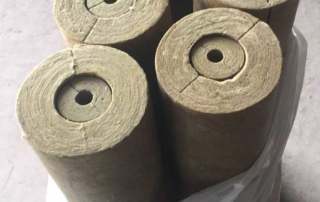
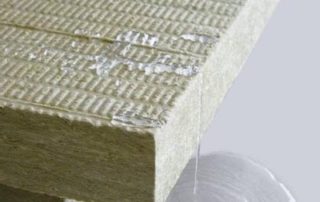
Soft & Rigid Spray Mineral Wool
EcoIn’s spray mineral wool is a blown-fibre insulation product available in soft (120–150 kg/m³) and rigid (200–250 kg/m³) densities, designed for fireproofing structural steel, acoustic treatment, and industrial thermal applications.
Quick Details:
- Packing: Heat-shrinking packing
- Density: 120-150kg for soft spray mineral wool, 200-250kg for rigid mineral wool
- Thickness: 22mm-100mm
- Delivery time: 7-15 days
- Payment terms: TT, LC, Westunion, Bitcoin, Trade Assurance
Ecoin spray mineral wool is specially designed for complex & irregular structure’s thermal insulation.
Technical Parameters
| Product Code | EC-S (soft spray mineral wool) | EC-R (rigid spray mineral wool) |
|---|---|---|
| Raw Material | granulated mieral fiber, grey color | granulated mieral fiber, white color |
| Density(kg/m3) | 120-150 | 200-250 |
| Conbusion Performance | Grade A | Grade A |
| Sound Absorbtion | NRC≥0.7(thickness=25mm) | NRC≥0.7(thickness=30mm) |
| Thermal Conductivity | ≤0.038 | ≤0.042 |
| Bonding strength | ≥1.7 | ≥25 |
Remarks: Other sizes available upon request.
ECOIN spray mineral wool has below features:
High adaptability to complex and irregular structure
Damp-proof
Good thermal insulation performance
Excellent sound absorption performance
Good safety and convenient performance
It can be both spray-applied to underground garage roof, engine room, equipment room, stadium, airport terminal, railway station, subway, for thermal insulation and sound absorption.
It can also be fill-applied to the ceiling, wall and floor of wooden structures and concrete structures, with excellent thermal insulation, fire protection, anti-condensation and sound insulation performance.
Application Gallary
[/fusion_gallery]Your Content Goes Here
Your Content Goes Here
Spray Mineral Wool – FAQ
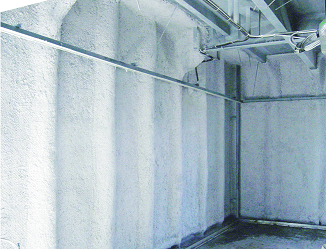
Spray mineral wool is an applied insulation solution for structural steel fireproofing and acoustic control. According to mineral wool research, spray-applied fibres bond directly to irregular surfaces, eliminating gaps common with pre-formed boards.
We supply two grades of spray mineral wool: soft spray mineral wool at 120–150 kg/m³ for acoustic absorption and lightweight fireproofing, and rigid spray mineral wool at 200–250 kg/m³ for structural steel fire protection (F60–F120 ratings). Both grades of spray mineral wool are available in thicknesses of 22 mm to 100 mm and can be applied by machine or manual spray equipment.
EcoIn spray mineral wool is classified A1 non-combustible to EN 13501-1, making it suitable for all construction fire resistance classes. Rigid spray mineral wool achieves F60 to F120 structural steel protection depending on application thickness and steel section factor. Independent test certificates conforming to ASTM E119 and BS 476 are available on request.
Spray mineral wool is widely used for: structural steel fireproofing in high-rise buildings and industrial plants; acoustic ceiling and wall treatment in auditoriums, offices, and mechanical plant rooms; pipe and vessel insulation in petrochemical facilities; and tunnel and underground structure fire protection. The blown-fibre format of spray mineral wool makes it ideal for complex geometries and confined spaces inaccessible to board insulation.
Spray mineral wool is applied using compressed-air spray machines mixed with water and bonding agents on-site. Surface preparation includes priming bare steel and masking adjacent finishes. A single pass typically deposits 20–30 mm. Spray mineral wool can be topcoated with decorative plaster finishes or left in its natural fibrous state for industrial use. Curing time is 24–48 hours before overcoating.
Spray mineral wool is packed in moisture-resistant polythene bags (20 kg each) in outer cartons. Delivery time is 7–15 working days after order confirmation. Payment terms include T/T, L/C, Western Union, Bitcoin, and Trade Assurance. FOB, CIF, and EXW incoterms are available for all order volumes of spray mineral wool.
EcoIn has exported spray mineral wool to contractors and distributors across Europe, the Middle East, and Southeast Asia for over 15 years. Our spray mineral wool is manufactured under ISO 9001 quality management with consistent fibre density, pH-neutral binders, and CE-marking documentation. Factory audits, third-party test reports, and OEM private-label packaging are available for large-volume spray mineral wool buyers.
Spray Mineral Wool – Frequently Asked Questions
According to Wikipedia, mineral wool is a fibrous material formed by spinning or drawing molten mineral or rock materials, widely used in thermal and acoustic insulation across the construction industry.
Blown-fibre mineral insulation offers a significant advantage over rigid board products: it can completely conform to complex geometries, irregular surfaces, and structural steel sections that would be impractical to insulate with pre-cut boards. When applied wet, the fibres bond to virtually any substrate — steel beams, curved pipes, concrete columns, and mechanical equipment housings — creating a seamless, gap-free insulating layer.
The mechanical adhesion achieved during application means the material self-adheres to vertical and overhead surfaces without fasteners or adhesives. Once cured, the resulting layer resists vibration, thermal cycling, and minor structural movement, maintaining its thermal performance over decades of service.
Because it is applied as a fluid mixture, the coating fills recesses, bolt heads, and weld seams that rigid boards would bridge over, leaving air gaps that compromise both thermal and acoustic performance. For complex structures like steel framework in industrial buildings or the underside of bridges, this seamless coverage is critical.
The fibrous matrix also provides a degree of acoustic attenuation beyond what its density alone would suggest. Vibration energy is dissipated within the interlocking fibre network, making this product useful not only for passive thermal control but also for reducing structure-borne sound transmission.
For projects where both fire resistance and thermal insulation must be met simultaneously — such as structural steel protection in commercial buildings — this blown-fibre mineral insulation eliminates the need for two separate product applications, simplifying the construction programme and reducing labour costs.
Fire performance is one of the primary reasons engineers specify this product on structural steel projects. Classified as Euroclass A1 under EN 13501-1 — the highest non-combustibility rating within the European classification system — it contributes no fuel load to a fire, emits no toxic fumes, and generates no burning droplets.
Under ASTM E119 and ISO 834 fire curve testing, spray mineral wool applied at the densities and thicknesses defined in the relevant certification documentation will protect the underlying steel member for the specified fire resistance period. Typical ratings range from 30 minutes (R30) to 120 minutes (R120) depending on the applied density (120–250 kg/m³) and thickness, typically 15–50 mm for most structural applications.
For passive fire protection (PFP) applications, the product must be applied in strict accordance with the approved system documentation. This includes substrate preparation (surface must be free of oil, loose scale, and moisture), primer coat where specified, and the correct thickness verified with calibrated depth gauges at the prescribed testing intervals.
This blown-fibre insulation has been used in a wide range of certified PFP systems covering columns, beams, and composite deck applications. Third-party certification from bodies such as Warrington Fire, EXOVA, or equivalent national testing institutes is available for the specific construction systems in which EcoIn’s product has been qualified.
For projects with specific fire rating requirements, our technical team can provide guidance on the required thickness and density combination, along with the applicable test evidence and assessment methodology, allowing your fire engineer to sign off the specification with confidence.
EcoIn supplies this blown-fibre mineral insulation in two distinct density grades, each optimised for different project requirements and performance targets.
The soft grade (120–150 kg/m³) is typically specified for thermal insulation of building envelopes, interior partitions, and mechanical services. At this density, the material combines low thermal conductivity (λ ≈ 0.036–0.040 W/m·K at 25°C) with excellent sound absorption, making it well suited to applications where thermal performance and acoustic comfort are both priorities. The lower density also reduces the dead load contribution to the structure, which can be a factor in large-span roof systems or prefabricated panel assemblies.
The rigid grade (200–250 kg/m³) is the standard choice for passive fire protection of structural steel and for applications where the insulating layer must resist mechanical damage without an additional protective finish. At higher density, the cured layer is robust enough to be painted or overcoated directly, and it maintains dimensional stability under sustained heat exposure well in excess of 1000°C.
When selecting between the two grades, consider the following factors. Fire resistance period: R60 and above on open steelwork typically requires the rigid grade to achieve adequate protection within practical thicknesses. Substrate orientation: overhead or steeply inclined surfaces may require the rigid grade, which develops higher early green strength and is less prone to sagging before the initial set is reached. Finish requirements: if a painted or trowelled surface finish is required, the rigid grade provides a better substrate. Your project specification should define the minimum density, not just the grade name, to ensure the applied material is verified against the design intent during inspection.
This blown-fibre insulation is used across a broad range of construction and industrial applications where rigid board products are impractical or insufficient.
In commercial and industrial buildings, the most common use is passive fire protection of structural steelwork — columns, beams, and connections. Major infrastructure projects including tunnels, airport terminals, and multi-storey car parks frequently specify this product because of the complex geometry of the steel members involved and the high fire resistance periods required.
Shipbuilding and offshore platforms represent another major application sector. The marine environment demands materials with both high fire performance and resistance to vibration and moisture ingress — requirements this fibrous mineral insulation meets without the weight penalty of concrete-based intumescent systems.
In industrial process facilities, the material is applied to equipment housings, ductwork, vessels, and pipe penetrations where a seamless, gap-free insulating layer is required around complex geometries. For piping systems with simpler geometry, our mineral rock wool board products may offer a more cost-effective alternative where board-and-wire installation is practical.
Cold storage and refrigerated logistics facilities use this blown-fibre mineral insulation in the roof and wall cavity of controlled-atmosphere buildings, taking advantage of its ability to fill irregular roof structures without thermal bridging at rafter positions. Agricultural buildings requiring fire separation also increasingly specify mineral-based solutions over organic-fibre alternatives because of the non-combustibility classification and resistance to moisture and vermin attack.
EcoIn supplies this blown-fibre insulation to projects across Asia, Europe, the Middle East, and the Americas, with a standard export lead time of 7 to 15 working days from order confirmation, subject to the production schedule at the time of enquiry.
Minimum order quantities vary by product grade and are discussed at the quotation stage. For most export orders, a full 20-foot or 40-foot container quantity is the practical minimum, though smaller trial orders can be accommodated for new customers undertaking specification testing or fire-rating verification prior to placing a full project order.
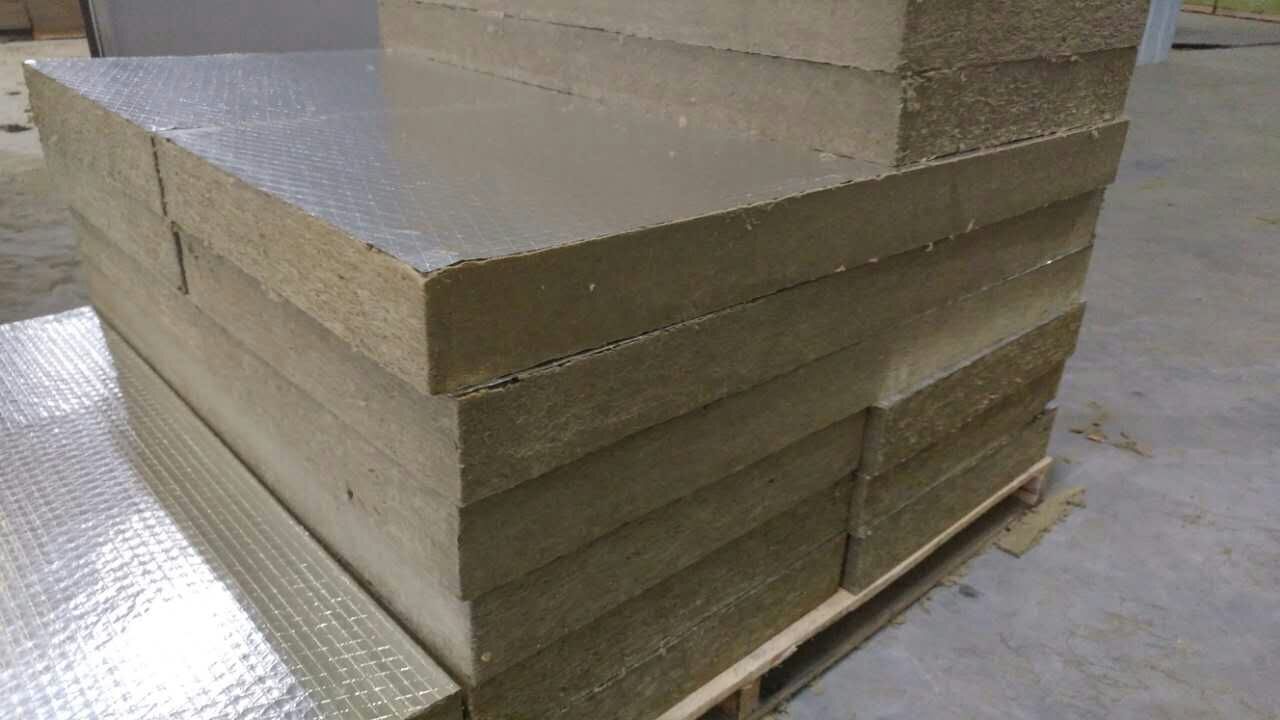
Packaging is heat-shrink wrapped in standard pallet configurations optimised for container loading. Each pallet is clearly marked with product grade, density, batch number, and production date to support project quality assurance records. All documentation required for customs clearance — including commercial invoice, packing list, certificate of origin, and third-party test reports — is prepared as standard for every shipment.
Payment terms accepted include Telegraphic Transfer (T/T) and Documentary Letter of Credit (L/C) at sight. For established accounts, 30% advance payment with 70% against copy of Bill of Lading is the standard arrangement. Technical data sheets, fire test reports, and safety data sheets (SDS) are available on request and can be submitted in advance of tendering to support specification writing and product approval. If your project requires specific certification documentation or witness testing as part of the supply contract, please include these requirements in your initial enquiry so they can be addressed in the technical proposal.
Related Products
Get A Quote Today
Your inquiry will be replied within 24 hours. The more accurate of your requirement, the more accurate and quick of our quotation will be.